

Process Development Services
AGC supports a wide range of contract synthesis projects.
- Fine Chemicals
- Electronic Materials
- Agrochemical Intermediates
- Agrochemical Active Ingredients
- Pharmaceutical Intermediates
- Active Pharmaceutical Ingredients (API)
Optimal process design improves quality, yield, and productivity.
- Safe and highly productive process design with full consideration of commercial manufacturing
- Seamless and consistent technology transfer from laboratory to manufacturing, achieving both high quality and short lead times
- Fundamental problem-solving through the development of entirely new synthetic routes from scratch
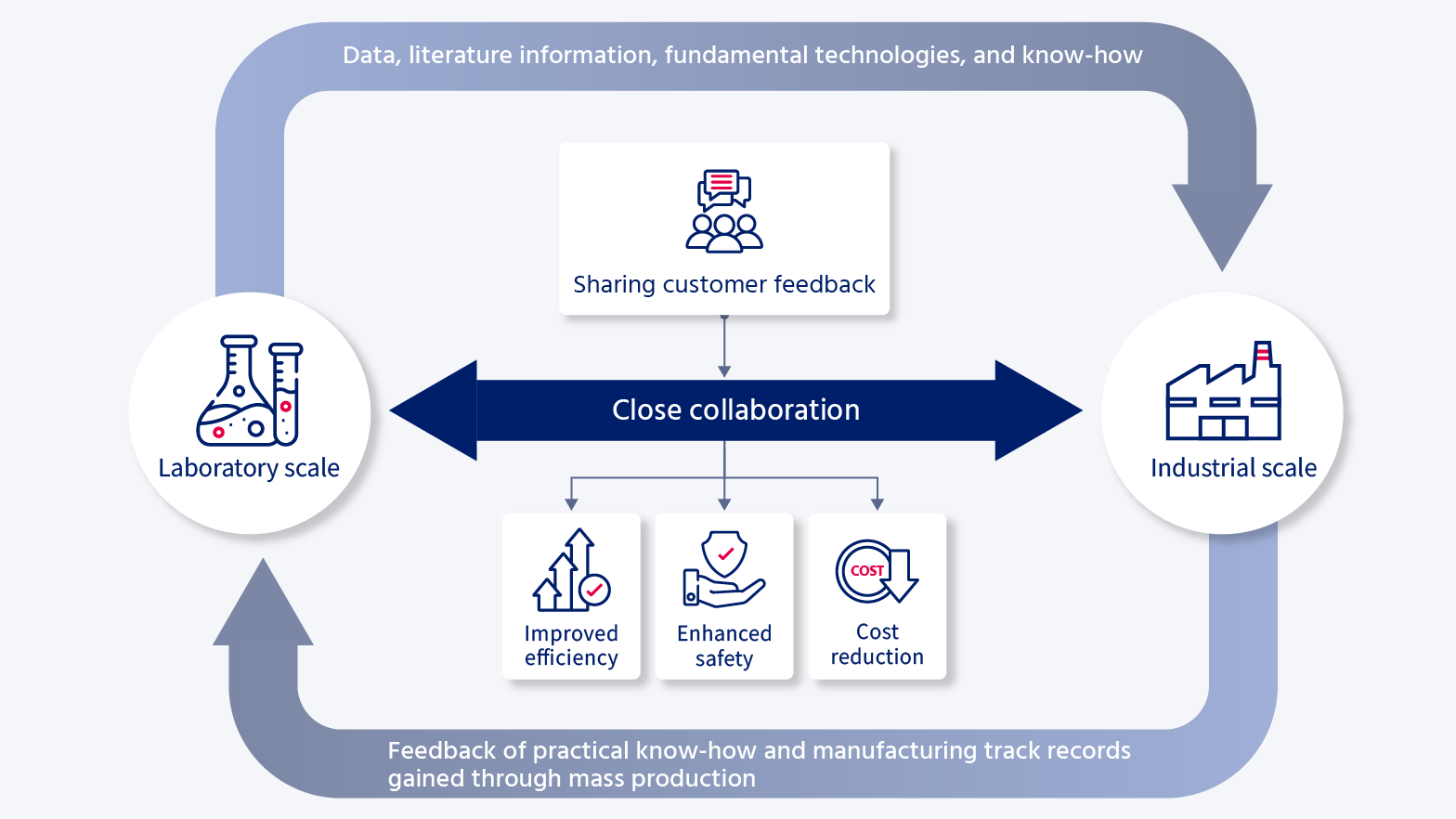
Process development bridging laboratory experiments and commercial production
In the chemical industry, process development is a critical technical field that safely and efficiently bridges laboratory-scale synthesis and industrial-scale manufacturing. Leveraging extensive experience and technical expertise, AGC provides optimal process development tailored to customer needs.

Utilization of accumulated know-how
Based on years of accumulated expertise in organic compound manufacturing, we can respond rapidly from preliminary studies through scale-up evaluation.

Collaboration between R&D and manufacturing departments
Close cooperation between R&D and manufacturing enables the rapid construction of optimal processes that consider mass production, achieving shorter lead times.

Optimization of reaction conditions and process improvement
Existing processes are comprehensively reviewed to improve reaction efficiency, reduce costs, enhance safety, and lower environmental impact. Factors affecting quality and yield, such as temperature, pressure, and catalysts, are optimized.
Support for constructing new synthesis routes from scratch
From early stages where only the target compound is defined, we design synthesis routes assuming commercial production. In addition to literature information, AGC integrates its proprietary manufacturing database with the knowledge of its research teams. Considering manufacturing feasibility, multiple factors such as yield, cost, productivity, equipment compatibility, and safety are evaluated to determine the optimal strategy.
Acquisition of various data for scale-up
We provide one-stop support from planning to execution of data acquisition strategies aimed at commercial production. Backed by our extensive know-how in data acquisition for establishing robust manufacturing processes, we offer optimal contract manufacturing services.

We also offer comprehensive support for complex regulatory submissions.
Based on extensive experience with applications under laws such as the Chemical Substances Control Law and the Industrial Safety and Health Law, we strongly support smooth commercialization. Leave even complex regulatory applications to us.
- Process Development Data
- Detailed synthesis routes, reaction conditions (e.g., temperature, pressure, time), process sequence, processing scale, and equipment specifications
- Physicochemical property data
- Purity, structure, melting point/boiling point, water solubility, pH, and partition coefficient of raw materials, intermediates, and final products
- Chemical reaction characteristics
- Reaction kinetics data; reaction heat (evaluated by calorimetry); types and quantitative analysis of by-products and impurities
- Stability data
- Long-term storage stability / accelerated testing, monitoring of product degradation rates and increases in impurities, and control of factors affecting safety
- Equipment capabilities and manufacturing conditions
- Specifications and capabilities of available equipment, ranges of reaction temperature and pressure, agitation conditions, and scale-up information
- Environmental and safety management information
- Waste liquid treatment methods, hazardous materials management information, operator safety management, and equipment cleaning procedures
- Manufacturing lot and process control information
- Lot size, manufacturing schedule, risk assessments for each manufacturing step, and process monitoring data